Seed cake - a common recipe with a royal twist
One of the aspects about Emily’s recipe book that I enjoy the most is that many of her recipes are attributed to someone that she knew or who was an ancestor. Researching these people is both entertaining and enlightening, often yielding unexpectedly interesting morsels of historical interest. Enter a simple recipe for common seed cake, attributed to ‘Lady Miller, my great-grandmother’. She was Susanna, wife of Sir John Miller, the 4th Baronet, and the daughter of Dr Matthew Combe of Winchester (1662–1748) and his wife Hannah. Matthew’s rather touching memorial in Winchester Cathedral reads (translated from the Latin inscription):
‘Equipped by natural genius, study and industry, he acquired with remarkable success the highest knowledge of healing. In tending to the sick he was diligent, caring, humane and conscientious; in his daily round of duties he was courteous, strenuous, a man of integrity and saintliness: and of such extraordinary and venerable piety towards God, that neither occupation nor recreation could distract him from constant worship.’
Susanna Combe and Sir John Miller married on 31 May 1733, when he was 23 but she was only 15. Though marriage at such a young age was uncommon, until the 1929 Age of Marriage Act, females over the age of 12 were permitted to marry. Over the next 16 years, Susanna was almost continuously pregnant, producing 11 children between 1734 and 1750, including Emily’s grandfather, Sir Thomas Miller, the 5th Baronet. Susanna must have had a strong constitution (plenty of seed cakes?)! She not only bore all those children but outlived her husband by 16 years and died in 1788, aged 80.
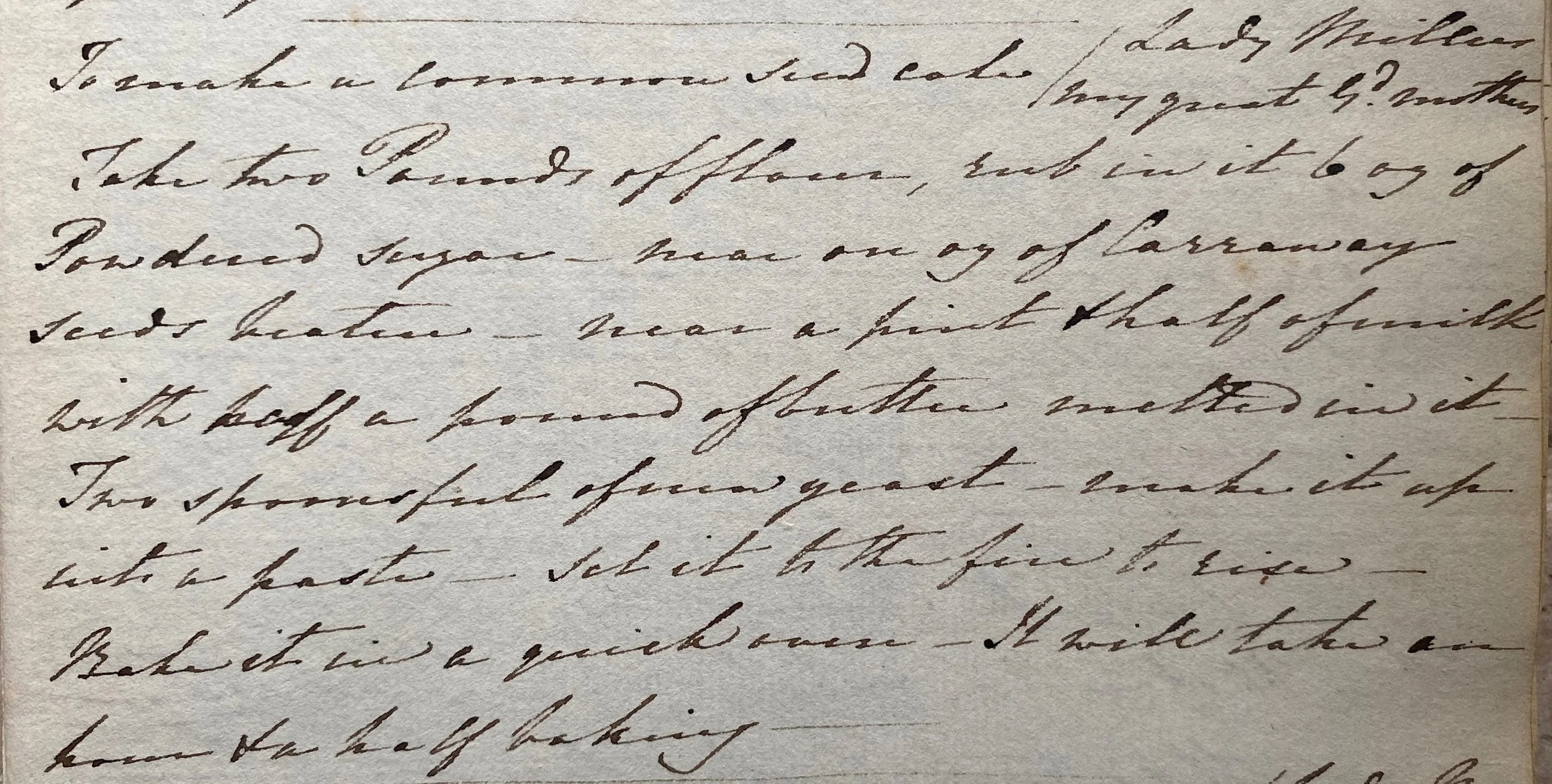
To make a common seed cake / Lady Miller, my great gd-mother’s
Take two Pounds of flour, rub in it 6 oz of Powdered sugar, mix an oz of Carraway seeds beaten – near a pint & half of milk with half a pound of butter melted in it – Two spoonsful of new yeast – make it up into a paste – set it to the fire to rise – Bake it in a quick oven – It will take an hour & a half baking –
Based on Susanna’s lifespan, this particular recipe must be at least 250 years old, but possibly even older. Research suggests that seed cakes likely originated in Tudor times. Certainly, they were hugely popular in the eighteenth century and were a ‘common’ teatime food of the nineteenth century. Most Victorian tea tables in all sorts of homes would have featured a seed cake – head over to You Tube to watch Mrs Crocombe make one. And a slice in the evening with a glass of fortified wine was considered a very satisfactory bedtime snack (note to self!)
Emily’s book includes three recipes for seed cake, as well as two for seed biscuits. Yet, seed cakes are rarely seen now and caraway seeds, with their mild aniseed flavour, are used far more widely in central European countries than in Britain. Caraway is an essential ingredient in sauerkraut, for example.
Though certainly intrigued to try Susanna’s seed cake, I didn’t have fresh yeast to hand so tried an alternative version without yeast (or butter), that came from Emily’s mother, Hannah.
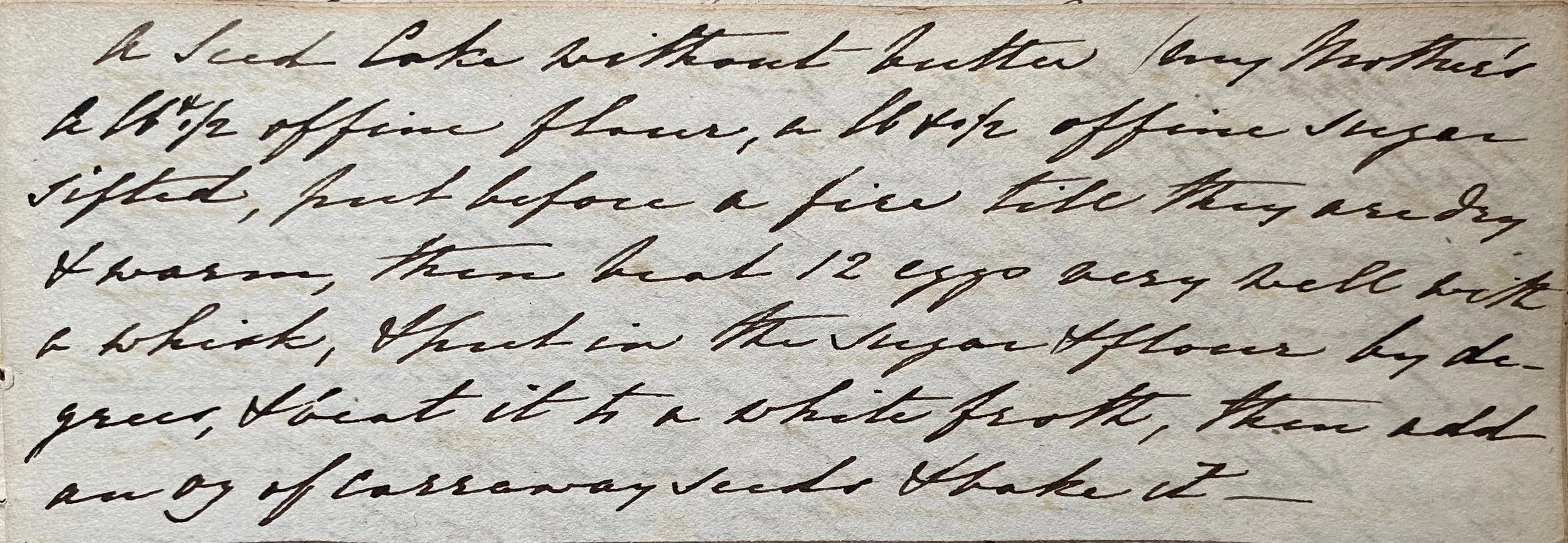
A seed cake without butter / My Mother’s
A lb & 1/2 of fine flour, a lb & 1/2 of fine sugar sifted, put before a fire till they are dry & warm, then beat 12 eggs very well with a whisk, & put in the sugar & flour by degrees, & beat it to a white froth, then add an oz of carraway seeds & bake it –
I decided to halve the recipe to reduce the number of eggs required and because I didn’t have enough people in the house to eat a large cake! Here is the recipe simplified and slightly adjusted, sufficient for a regular loaf tin.
Sift together 340g of plain flour and 300g of caster sugar into an oven-proof bowl and put in a low oven for about 5 minutes.
Meanwhile, in a large bowl, whisk 6 eggs until well beaten, then gradually add the sugar and flour mixture and beat well until pale in colour (NB I was unable to achieve a ‘white froth’ and the mixture became too stiff even for an electric whisk – but it did look well aerated)
Fold in 1 tsp (or perhaps 2 tsp – see below) of caraway seeds
Pour into a lined loaf tin and bake in a preheated 180°C oven for about an hour until well risen and golden brown on top
The verdict? Extremely easy to make, and it was in the oven within 10 minutes. It is quite a dry cake though and I think it needed another teaspoon of caraway seeds for a better flavour, but I still enjoyed a slice with a cup of tea. And I enjoyed it even more in the evening with a whisky and a hunk of cheddar!
As for the royal twist? Well, it turns out that my six-times great-grandparents, Sir John and Lady Susanna Miller, were also the six-times great-grandparents of HM Queen Camilla. John and Susanna’s daughter, Anne, married George Keppel, 3rd Earl of Albermarle – it was their great-great-great-grandson, George, whose wife Alice Keppel, Queen Camilla’s great-grandmother, was the mistress of Edward VII. Just goes to show that you never know what will be revealed when you start following the branches of family trees! It’s another interesting aside to note that Queen Camilla’s son, Tom Parker-Bowles, is an authority on British food. His most recent book, Cooking and the crown: Royal recipes from Queen Victoria to King Charles III, is a delectable feast of historical recipes.

Emily’s great-aunt (and Queen Camilla’s five-times great-grandmother), Anne, Countess of Albermarle – the seed cake recipe is her mother’s (attr. circle of Nathaniel Dance-Holland, via Wikimedia)
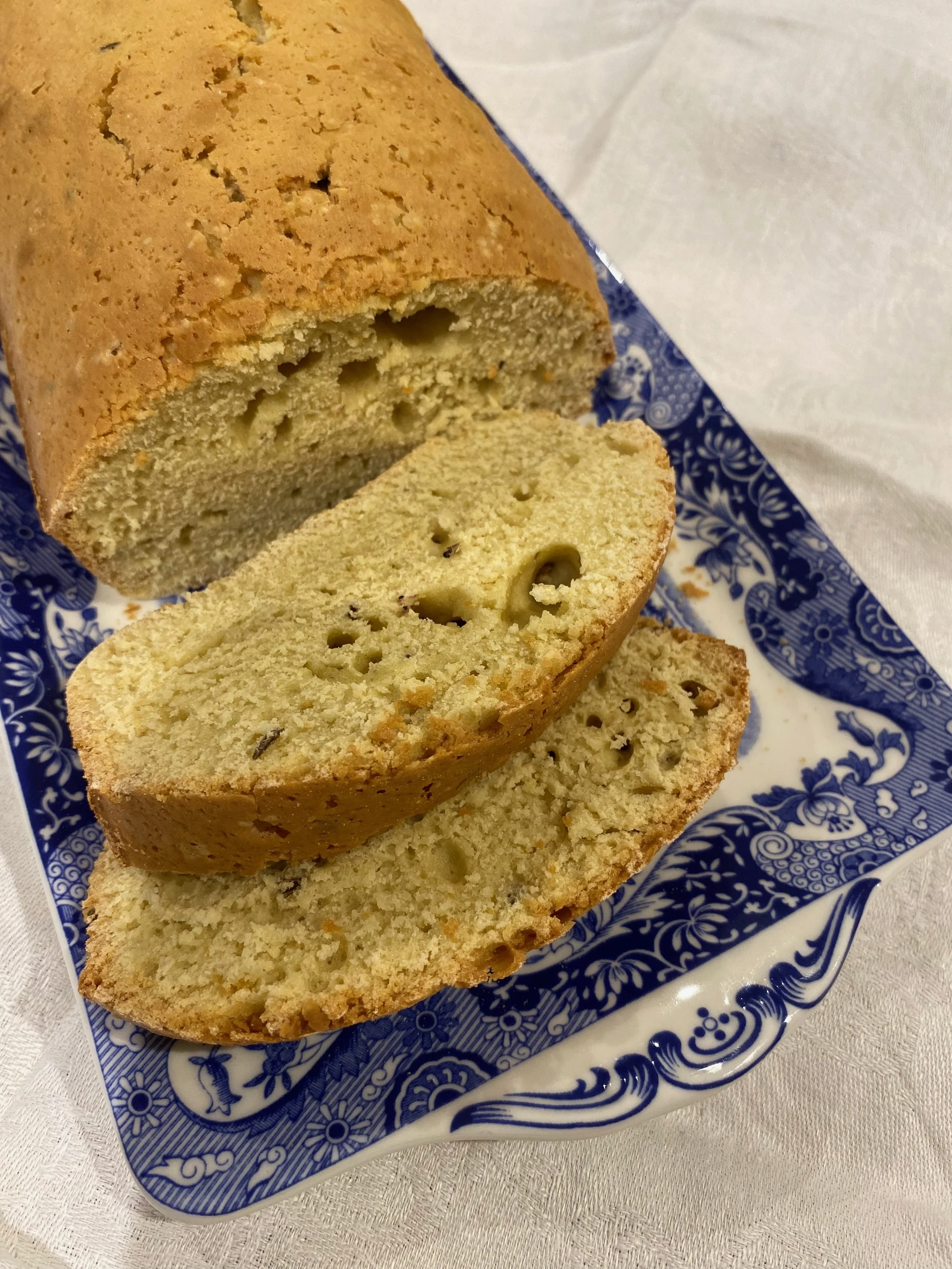
Seed cake without butter (but whisky recommended!)